Accelerating Research for DYNC1H1-Related Disorders: Our Path to a Cure.
The DYNC1H1 Association serves as the central force in advancing research and treatment for DYNC1H1-Related Disorders (DRD). We are the only organization 100% dedication to finding treatments for DRD. Our mission for a cure has multiple initiatives:
Funding research to find safe, effective cures for all individuals affected by DYNC1H1-related disorders
Identifying, connecting, and supporting patients worldwide through awareness and education.
Building networks between researchers, clinicians, institutions, and industry partners as a part of advocating for increased research attention and funding
Through these efforts, we can create the foundation necessary for developing effective treatments. In this blog post, we will detail the different steps of the Drug Development Pipeline, how the DA is involved, and how You can help us succeed in our mission for highly effective, low risk treatments for all individuals with DYNC1H1-related disorders
Our Path to a Cure
-
The foundation of rare disease research begins with understanding how the condition affects people over time. We work closely with Simons Searchlight and other research partners to conduct natural history studies, which systematically track how DYNC1H1-Related Disorders progress in different individuals. These studies help our researchers:
Identify common symptoms, their severity, and common comorbidities.
Track disease progression patterns
Understand quality of life impacts, including interventions that work or fail.
Determine which symptoms most need addressing.
Design better clinical trials that are accessible, meaningful, and have achievable measures for patients and their families.
How to Participate in the DYNC1H1-Related Disorder Natural History Study:
Register with Simons Searchlight
Submit your genetic report
It is much easier and faster to be included in the study if you are able to submit the genetic report rather than having Simons Searchlight reach out to your medical institution. Often you can reach out to your medical provider through MyChart or similar online portals to request a digital copy of the report.
If you did not submit your report upon registering, but have a copy of it, you can email coordinator@simonssearchlight.org to submit the report.
After submitting, it usually only takes 2 business days to be approved.
Complete initial and/or annual medical surveys
Participate in research interviews
Keep detailed health records to share as needed.
Share medical documentation as requested by Simons Searchlight.
Collect gift card rewards
-
While understanding what is happening in people is vital, new drugs cannot go directly from the lab into people. Before testing potential treatments, researchers need accurate, non-human models of the disease. These models are key pre-clinical tools necessary to speed up the development of treatments and understand the underlying cause of disorder symptoms.
We are working with partners to create induced pluripotent stem cells (iPSCs) from both patient-derived samples and existing cell lines modified to carry DYNC1H1 mutations.
The iPSC development process includes:
Either collecting patient samples or modifying existing cell lines
Reprogramming adult cells into stem cells (iPSCs).
Validating and characterizing the disease symptoms and underlying processes that cause symptoms and protein dysfunction
Measure different cellular processes to create tests for cell health in DYNC1H1 disorders.
Use the cells to test potential treatments by giving the cells medicine to see if their symptoms improve, stay the same, or are worsened.
This crucial step helps our researchers understand disease mechanisms and test treatments before moving to clinical trials. We accelerate this process by:
- Funding iPSC development
- Coordinating sample collection when needed
- Facilitating collaboration between labs
- Supporting data sharing
- Selectively choosing collaborative partners who share our goal of a cure for DRD.
The DYNC1H1 Association’s goal for the end of 2025:
1 patient derived cell line available to researchers via biorepository. MET
2 isogenic cell lines with DYNC1H1 mutations edited into them available to researchers via biorepository. ALMOST - lines going through final steps of development.
Why? Each patient is different so having models of different variants is important. We hope to continue to expand the number of models available to researchers and our understanding of them in 2026 and beyond.
Each patient-derived stem cell line costs around $10,000 to make, and each genetically edited line costs over $20,000 to make. Your donation can help empower us to make the next model, and find treatments for all DRD patients faster. DONATE TODAY.
-
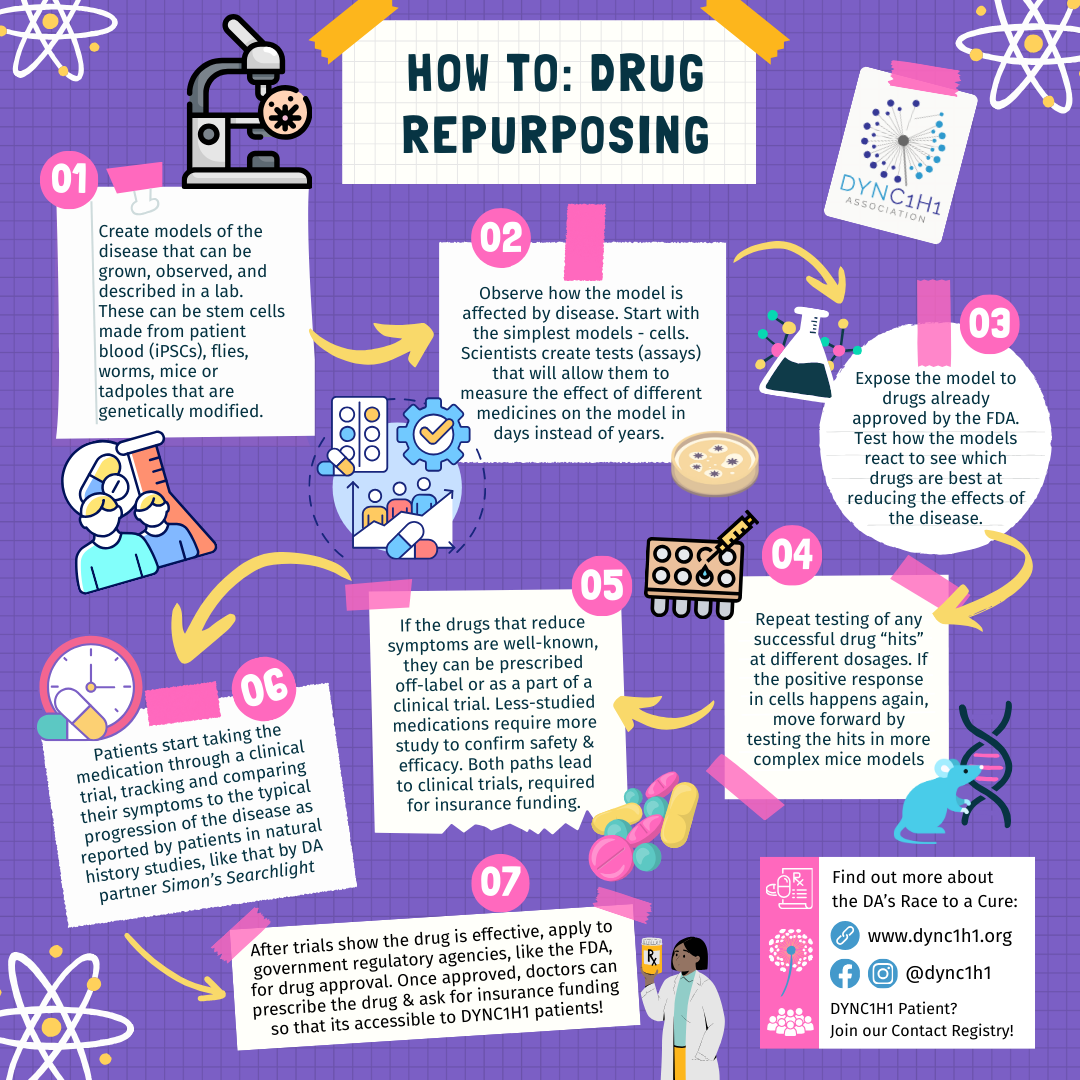
With disease models in place and symptoms in people well documented, researchers can begin the next steps for testing potential treatments. The DYNC1H1 Association is the driving force behind:
- Connecting researchers with pharmaceutical companies
- Funding promising research projects, such as drug repurposing studies that may use the disease models we helped develop.
- Facilitating multi-center collaborations so that there is sufficient infrastructure in place for future clinical trials to be low burden.
- Using data from the Natural History Studies to figure out usable medical markers to create a successful clinical trial.
- Advocating for increased industry involvement in DRD drug development.
- Advocating for inclusion of DRD patients in clinical trials for drugs targeted at similar conditions and symptoms.
This phase in the race to a cure includes:
- Screening potential drug candidates in the disease models (stem cells induced to become neurons).
- Optimizing promising compounds to ensure they are in a form that is effective and accessible to the population (refrigeration needed vs. shelf stable)
- Testing safety and efficacy in cells and then more complex model organisms like mice or brain organoids.
- Developing delivery methods (IV vs oral suspension vs pill)
- Establishing dosing guidelines (how much medication is safe but still effective)
This stage typically takes 5-10 years, but can be accelerated with adequate funding and resources. Help us get these resources. DONATE TODAY
How the DYNC1H1 Association Drives Progress
We accelerate research through:
1. Research Funding
- Supporting natural history studies
- Funding disease model development
- Supporting clinical trial preparedness
2. Community Building
- Connecting patients to ongoing and new research studies
- Facilitating data sharing, including participating in Simons Searchlight
- Creating networks between clinicians & researchers worldwide
- Fostering industry partnerships
3. Resource Development
- Creating patient registries
- Supporting biobanking initiatives
- Establishing research networks
- Creating educational materials
Two ways you can help
-
Join the DYNC1H1 Association community by registering with our Patient Contact Registry
Register with Simons Searchlight, submit your genetic report, do the surveys, and receive gift cards.
Reply when we email! Join our events, speak up in a community chat, give feedback, share your story!
Complete health surveys each year through Simons Searchlight
Complete surveys sent out by DYNC1H1 Association to help guide us so that we can best serve you.
Volunteer with us: We’re a small group of motivated parents, and are always looking for helpers!
Host a fundraiser!
-
Organize community fundraisers, see the Fundraising manuals to help
Share your story, success, struggles, or just photos & videos.
Tag us on social media, like and share our posts! @dync1h1
Connect with other affected families
Research is expensive, but funding is achievable through combined efforts:
$100,000 can support drug repurposing studies on three DYNC1H1 gene variants.
$250,000 can develop stem cell models into petri dish brains, used to study epilepsy and brain development.
$500,000 can fund preliminary drug screening in cells, then mine.
$1,000,000 can support comprehensive preclinical studies.
The Path Forward
While developing treatments for DYNC1H1-Related Disorders is complex, we provide the framework and connections needed to make progress. Every contribution, whether through participation in research, fundraising, or raising awareness, builds upon our foundational work.
Taking Action
1. Connect with our team at the DYNC1H1 Association by joining the Patient Contact Registry, signing up for our newsletter, or joining our Research Network if you are a new or old scientist or clinician with an interest in cytoplasmic dynein or DYNC1H1 related disorders.
2. Register with Simons Searchlight or check your account to see if you have any outstanding surveys (or gift cards!)
3. Discuss research participation with your family, or reach out to us to see how you can get involved.
4. Explore ways to support our fundraising initiatives, or volunteer to run a fundraising event!
5. Share information within your community about the DYNC1H1 Association and how it’s driving a cure for your family member(s).
Through our leadership and our community's sustained commitment, we can accelerate the development of treatments for DYNC1H1-Related Disorders. Every step forward, supported by our combined efforts and coordination, brings us closer to our goal.