

Opposite directed motor proteins cooperate, rather than compete, to move cargo in cells
A large, collaborative group of scientists recently did experiments that answer long-standing questions about how material moves around in cells. One of the proteins they studied was the molecular motor dynein, whose job is to move cargo towards the middle of the cell, and which is not as efficient in cells of people with DYNC1H1 variants. Although these scientists studied molecular motors in test tubes, their research may have implications for understanding how cells coordinate effective cargo transport and developing strategies to make that transport more efficient.
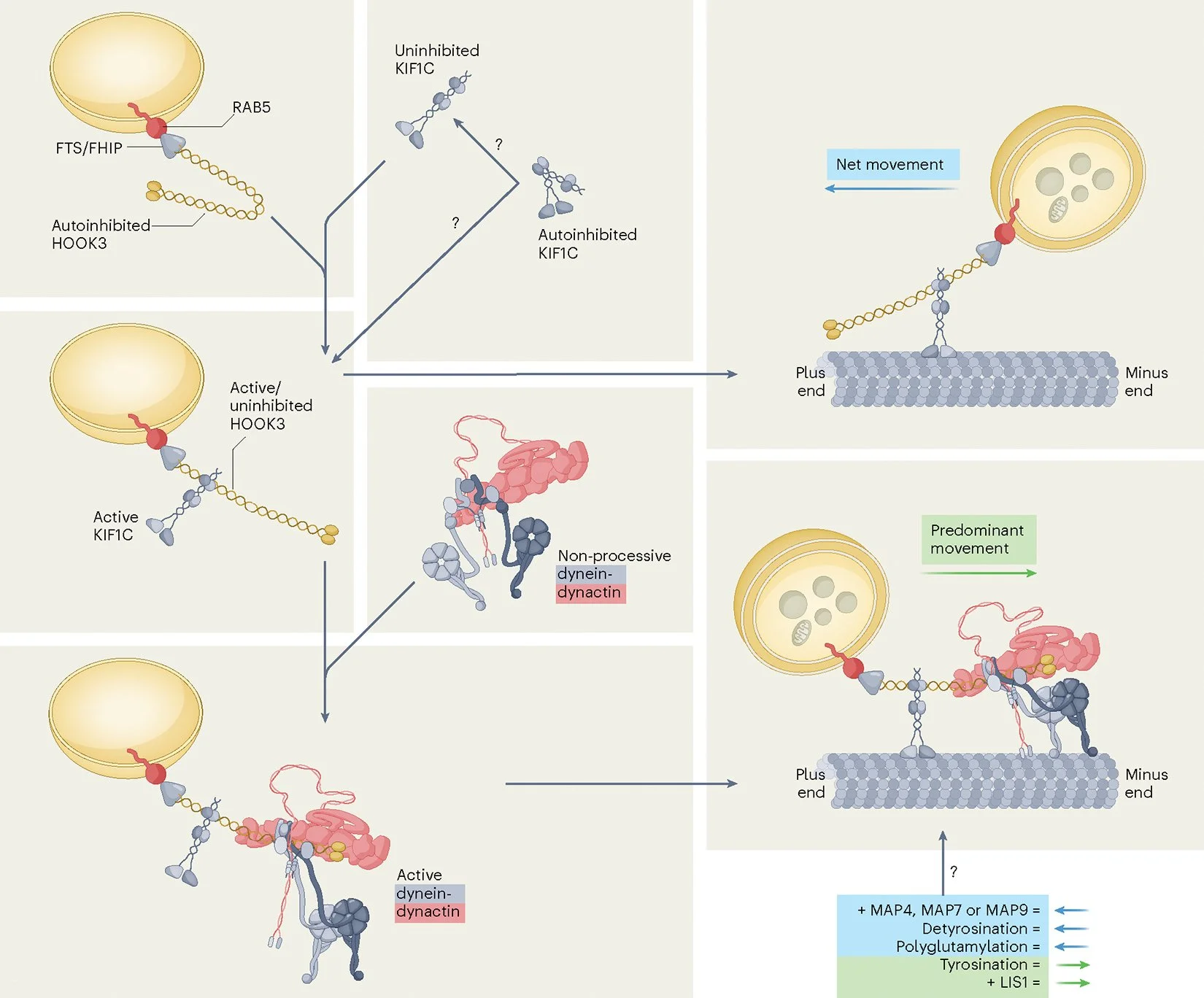
Activation of cargo transport by kinesin.
Markus, S.M. Nat Struct Mol Biol 32, 595–597 (2025). https://doi.org/10.1038/s41594-025-01524-6
Motor proteins and cellular shipping
The cells in your body can be many different shapes. In your skin, the cells are big and flat to form a strong layer that covers your body. Your red blood cells are tiny and round so they can fit through your narrowest blood vessels. And your neurons, the cells that wire your brain, are long and skinny. This unusual shape means that neurons have a problem; the furthest end of a neuron might be far from the main body of the cell, which scientists call the soma. The soma is where most important materials get made, even if these materials have an important job to do very far away. To get these important cargos to their proper destinations, the cell has a shipping system.
The cellular shipping system has a lot in common with the way cargo gets moved around the world by train. The engines that drive cargo movement in cells are called motor proteins, and they move on rails called microtubules. Much like a steam engine on a railroad, these motors can only drive in the direction they are pointing, and they can’t go in reverse. A steam engine on a rail facing North will only drive North; similarly, a kinesin motor protein in a cell can only move away from the soma. To move cargo in the other direction, the equivalent of a South-facing engine is a type of motor protein called dynein that only moves towards the soma. Adaptor proteins act like cargo hitches to connect these motors to cargo. Cargo that needs to move away from the soma will be hitched to a kinesin, and cargo that needs to move towards the soma will be hitched to a dynein.
Open Questions
Things move a lot faster at the microscopic level than they do on the railroad. Unlike on a railroad, cargo in a cell may need to stop or switch direction on short notice. But when it’s carried by motor proteins that can only go one way, how can the cargo double back so quickly? To solve this problem with steam engines, you would need a North-facing engine and a South-facing engine hooked up to the same boxcar at the same time. To switch directions, the North-facing engine would need to cut power while the South-facing engine fired up the boiler.
For years, scientists have seen that a single piece of cellular cargo is attached to both kinesins and dyneins, and can switch directions rapidly in cells. There was debate over whether the non-driving motor passively rode along, pulled against the driving motor, or even somehow helped the driving motor work better.
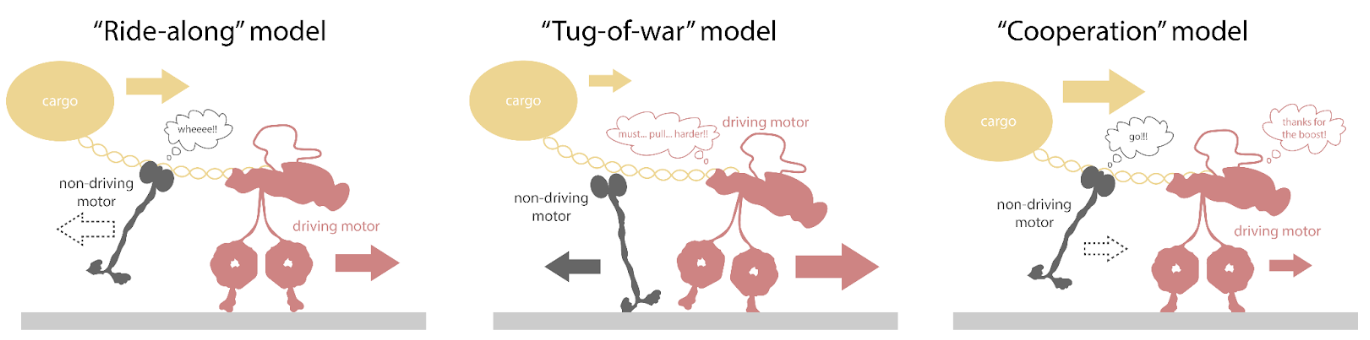
Three Dynein Transport Models by Maya English
Microscopy experiments show cooperation
A common way scientists study the behavior of molecular machines is by taking them out of cells to see how they behave in a controlled environment. The scientists who published this paper extracted dynein, one type of kinesin, and an adaptor complex from cells. The researchers did their experiments in vitro, from the Latin for “in glass” (although most test tubes these days are plastic). One difference between the experiments in this paper and previous work is that these experiments a kind of adaptor protein that is present in cells, while other scientists doing these types of experiments used artificial adaptors.
First, they used a technique called TIRF microscopy. Most microscopes look down on a sample, so the light passes all the way through it. With TIRF, the light bounces off the sample at a shallow angle, allowing scientists to see much more detail about what happens right on the surface. If you’ve ever looked through a window and thought it was clean, before putting your face closer to the glass looking at it sidelong only to realize how much dirt you could see at this angle, you did something very similar to TIRF microscopy. With this technique, scientists could take the microtubules out of cells, stick them to a glass microscope slide, and watch in detail as cargo zoomed along them.
Using TIRF, scientists found something surprising. Cargos being carried by dynein moved faster and further when kinesin was present as well, compared to dynein alone. Cargos being carried by kinesin moved more slowly when dynein was also present, but kinesin was able to more quickly and easily grab onto the cargo in the first place.
Structure explains function
The cargo adaptor protein these researchers studied is a complex of proteins called FTS–HOOK3–FHIP1B (FHF for short). Much like a complex machine in the real world, a careful look at the structure can reveal hints about how it works. To determine the shape of this motor, the researchers used a combination of two techniques.
The first technique was electron microscopy, or EM. The wavelength of light is too big to see molecular details inside of cells. Instead, EM passes an electron beam containing a sample of very concentrated protein. The beam cannot travel through the proteins, so every one of the millions of proteins casts a shadow. Even though a single shadow is not enough detail to build a 3D model, by averaging and “back-projecting” these shadows, the shape of a molecule can be reconstructed.
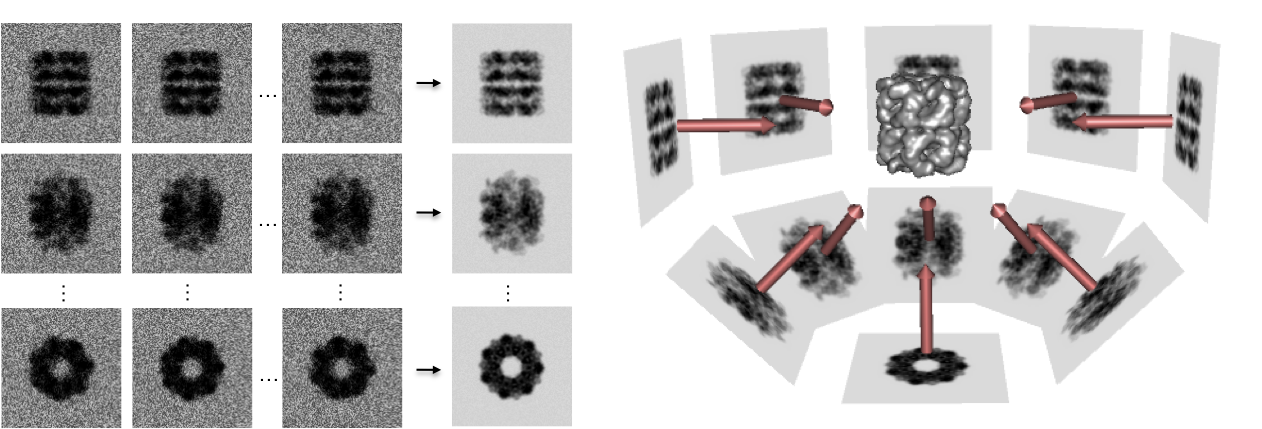
2D classification and 3D reconstruction from individual particles. Credit: Greg Pintilie
The researchers combined their EM data with predictions made by AlphaFold, a Nobel Prize winning AI program that is trained on thousands of proteins whose structures have been revealed with EM or other structural methods.
They found that the FHF cargo adaptor is folded in half when it is alone, and opens up when kinesin attaches to it. This type of behavior is called autoinhibition; kinesins and dyneins also fold in half when they are not involved in cargo transport to keep from getting into trouble. The discovery that FHF is autoinhibited may explain how kinesin helps dynein move cargo, as FHF’s unfolding when kinesin binds reveals a binding site for dynein to attach as well.
Future directions
If dynein is not working well and too much cargo is accumulating at the edge of the cell furthest from the soma, it might make intuitive sense to inhibit the activity of kinesins to solve this problem. However, now that we know how kinesins actually help dynein, this opens up new potential strategies to help dynein move in genetic conditions that are caused by dynein being a less effective motor.
It still isn’t completely clear how the kinesin these researchers tested helps dynein move further and faster. It’s surprising that the kinesin they tested neither pulled against the dynein nor completely detached from the track, and other researchers doing similar experiments have seen the kinesin behave differently. Since these experiments were done with purified protein, it’s also not clear if the way these proteins behave in a test tube is the same way they behave in a cell or an organism.