
Understanding the Literature: Brief Review of Publication focused on SMA in DYNC1H1
Blog post written by: Amish Bhatnagar, undergraduate student at UC Berkeley
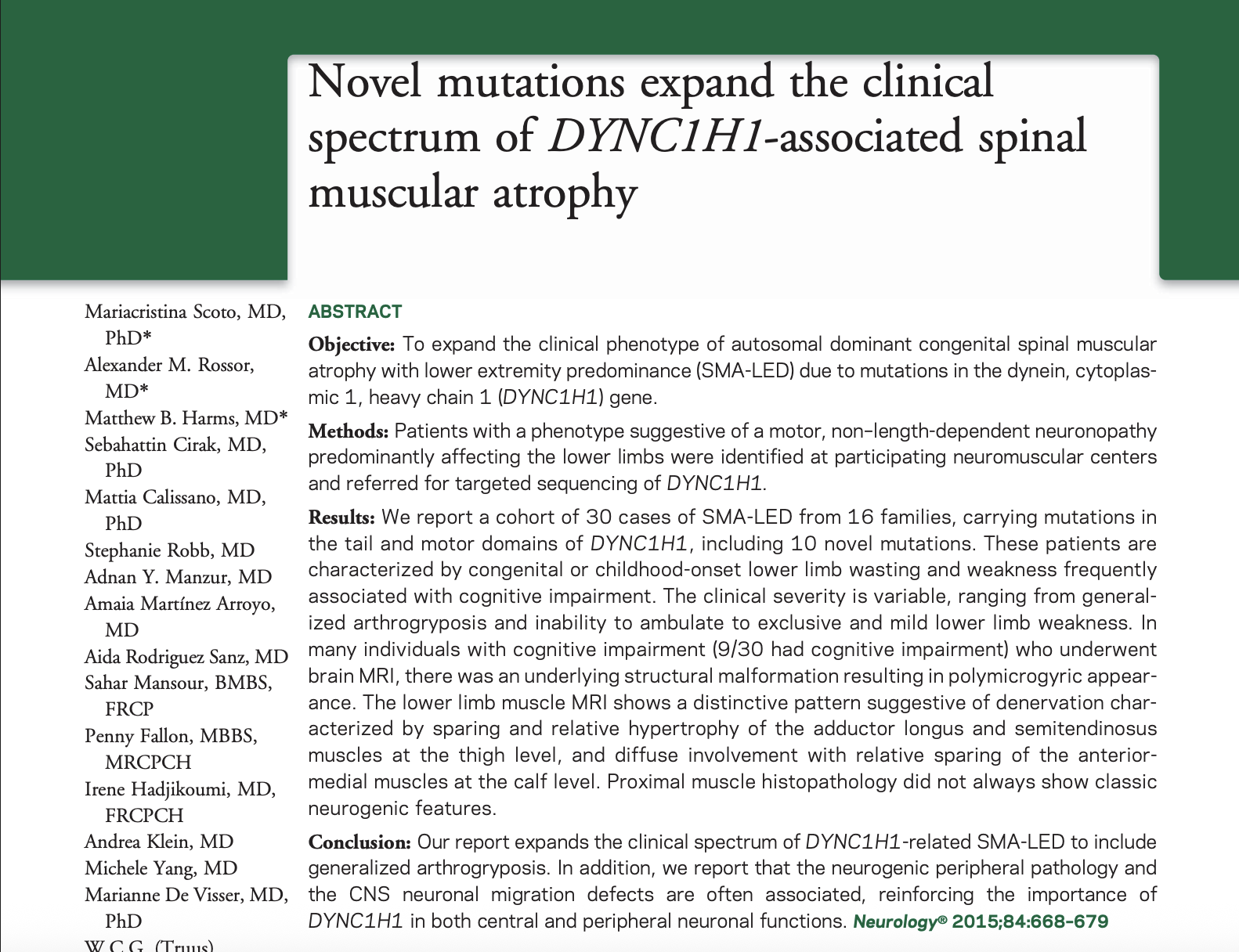
In 2015, researchers Scoto, Rossor, Harms and colleagues published an important study on spinal muscular atrophy with lower extremity predominance (SMA-LED) in DYNC1H1. They reported on 30 patients from 16 families that had phenotypes suggestive of a motor, neuronopathy predominantly affecting the lower limbs. Here were the key findings.
To begin, what is DYNC1H1? DYNC1H1 is a gene that encodes motor protein - cytoplasmic dynein. Dynein is a large, complex motor protein found in your cells that carry cargo along microtubules, which act as highways inside cells. This process, called retrograde axonal transport, is crucial in nerve cells for moving cargo over long distances. When DYNC1H1 mutates, it impairs cargo transport between nerve cells, which is why this condition mainly affects muscles, nerves, and the brain.
Scoto and colleagues (2015) first note that even within SMA-LED presentations of DYNC1H1 mutations, individuals’ symptoms are highly variable. Symptom onset ranged from in utero to late adulthood. For example, some babies were born with lower limb malformations, severe stiffness of joints and were never able to walk. While other individuals reported no symptoms until they were in their late 40s. Yet, other individuals reported being ambulatory but having leg weakness and an awkward gait. In addition to symptom affecting the lower limbs, individuals reported a range of other symptoms. About 1 in 3 patients had cognitive impairment or ADHD. Some cases reported a brain malformation, called polymicrogyria, in which the brain's surface has too many small folds, caused by problems during early brain development. Another notable finding from Scoto et al. was that this sample of patients were all generally stable. None of the patients who could walk lost that ability over time. This sets DYNC1H1 apart from other conditions that cause a steady decline in health.
A highlight of key findings:
- Age range at examination: 1 year old to 80 year old
- 37% presented at birth with lower limb malformations, 23% presented in infancy (motor delays and abnormal gait), and 17% in childhood (gross motor difficulties or frequent falls). Around 20% presented in adulthood with a variable degree of lower limb weakness.
- About 50% had foot deformities (equinovarus or valgus feet and pes cavus or planus) and joint contractures (hips, knees, and ankles).100% of the 23 individuals who had nerve conduction studies and EMG performed showed a motor neuropathy/neuronopathy without sensory involvement.
- Of the 13 individuals that had undergone muscle biopsy (usually of a quadriceps muscle), most biopsies showed chronic denervation.
- Of the 15 individuals who had brain MRIs, 4 showed polymicrogyria
This study provided an important step in DYNC1H1 research by publishing a range of presentations in individuals with DYNC1H1. This research, along with more recent studies, are only possible because patients participated in research studies and shared their experiences. Your voice matters. Join the Patient Registry today. We also encourage you to enroll in Simons Searchlight and Citizen Health to make sure your experiences are included in future research.
Full Citation: Scoto, M., Rossor, A. M., Harms, M. B., Cirak, S., Calissano, M., Robb, S., ... & Muntoni, F. (2015). Novel mutations expand the clinical spectrum of DYNC1H1-associated spinal muscular atrophy. Neurology, 84(7), 668-679.
Link to Full Paper: https://pmc.ncbi.nlm.nih.gov/articles/PMC4336105/pdf/NEUROLOGY2014607051.pdf