

PACS1 syndrome mutation disrupts dynein-mediated cargo transport
A collaborative group of scientists recently made a discovery about a rare syndrome that may reveal bigger truths about how material moves around in cells. They showed that the mutation in the protein PACS1 that causes PACS1 syndrome also makes dynein slower and less likely to start when stopped. This causes an important cellular organelle called the Golgi to break apart. Dynein also becomes a less efficient motor in cells of people with DYNC1H1 variants, so understanding proteins dynein interacts with is a step towards helping dynein do its job better. To read original peer-reviewed article: https://www.nature.com/articles/s42003-026-09924-0
What is PACS1 syndrome?
PACS1 syndrome is a rare neurodevelopmental condition caused by a mutation in the piece of genetic code containing instructions to make the protein PACS1. A single change from a C to a T in the DNA sequence is translated to a single substitution in the protein sequence, replacing the correct amino acid with the wrong one.
Biologists talk about protein mutations in two different ways. “Loss-of-function” mutations cause a protein to be less effective at its job, or produced in lower quantities. This is a problem if a protein has a vital job that now cannot get done. It can be helpful to imagine a car with no gas pedal, or with fewer horsepower than it needs. On the other hand, “gain-of-function” mutations occur when a mutant protein has interactions or functions it shouldn’t have, which can be even more problematic than the protein being unable to do its job. If a loss-of-function mutation is a car with no gas pedal, gain-of-function mutations are a car with no brakes, or stuck in a high gear.
The mutation that was studied in this paper is called PACS1R203W. All protein mutations are named this way, so it’s useful to understand what each part of this random-looking string of letters and numbers means. “PACS1” is the name of the protein. Like all proteins, it is made of a long string of building blocks called amino acids. In the superscript, R is the shorthand for the amino acid arginine. The number 203 means that this particular arginine is the 203rd amino acid in the 963 amino acid-long sequence of PACS1 (in total, this protein has 46 arginines!). Last, the W in that name is short for the amino acid tryptophan.
A single substitution of one amino acid for another seems like it should be no big deal, especially when that amino acid is only one of almost a thousand. After all, a page of text with a single typo is still readable. But proteins fold up into complicated shapes in order to do their job; like a single screw on an aircraft, the location of an amino acid in that 3D structure determines how much of a problem it would be if that amino acid was missing or different. If the screw was inside the plane– holding your tray table in place, for example– its absence would be annoying. If the screw was somewhere like the landing gear or wing mechanism, its absence would be a much bigger issue!
PACS1 interacts with dynein in cells
The researchers used a type of experiment called co-immunoprecipitation to figure out what proteins PACS1R203W directly interacted with, a clue towards what it might be doing in cells. This type of experiment works kind of like fishing, where the protein of interest (in this case, PACS1) works like a fishhook. Scientists are able to extract this protein using a specific tool that can “pull” the protein out of cells. Any other proteins PACS1 is touching inside of cells should be pulled out along with PACS1, like a fish on the hook. The co-immunoprecipitation experiment showed the mutant version of PACS1 pulls three times as much dynein out of the cells compared to non-mutant PACS1. Dynein is a protein that acts like a molecular motor, and can carry cellular cargo away from the edges of the cell and towards the nucleus. The fact that PACS1R203W pulled more dynein out of cells than non-mutant PACS1 means that PACS1R203W probably interacts with dynein more strongly or more often than non-mutant PACS1. Before this research was done, nobody knew that either mutant or non-mutant PACS1 had any kind of direct interaction with dynein at all!
PACS1R203W interferes with dynein to mess up cellular sorting
Next, the scientists wanted to know if the interaction of PACS1R203W with dynein was involved in PACS1 syndrome, since PACS1 also has other functions that could be more important to PACS1 syndrome than its interaction with dynein. Something the scientists observed in PACS1 patient cells was that the Golgi, an important organelle near the nucleus, was more spread out and fragmented than in cells of patients without PACS1 syndrome. The Golgi is like a cellular version of a post office sorting center; after proteins are made, the Golgi helps ensure that they are packaged and shipped to the right places inside or outside the cell. When the Golgi is too spread out, cellular supply chains collapse. Interestingly, other scientists studying dynein showed that dynein dysfunction could have a similar effect on the Golgi.
The scientists wondered if the Golgi fragmentation they observed in their PACS1 patient cells was related to the interaction they had just discovered between PACS1 and dynein. If PACS1R203W caused the Golgi to disperse by making dynein work less well, reducing the amount of functional dynein in a healthy cell should have the same effect as introducing the PACS1R203W mutation. If dynein was not involved in the Golgi dispersal they saw, inhibiting dynein should have no effect on the Golgi. The scientists saw that the Golgi of cells without PACS1R203W, but with dynein inhibition, looked exactly like the Golgi of PACS1 patients. Specifically, they saw that the part of the Golgi where cargo exits (called the trans-Golgi network or TGN) was disorganized. In a post office, this would be like if packages could be sorted correctly, but there were issues with getting the packages onto the right trucks. Altogether, this means that the interaction of dynein with PACS1R203W is the likely cause of the Golgi disorganization that is seen in PACS1 patient cells.
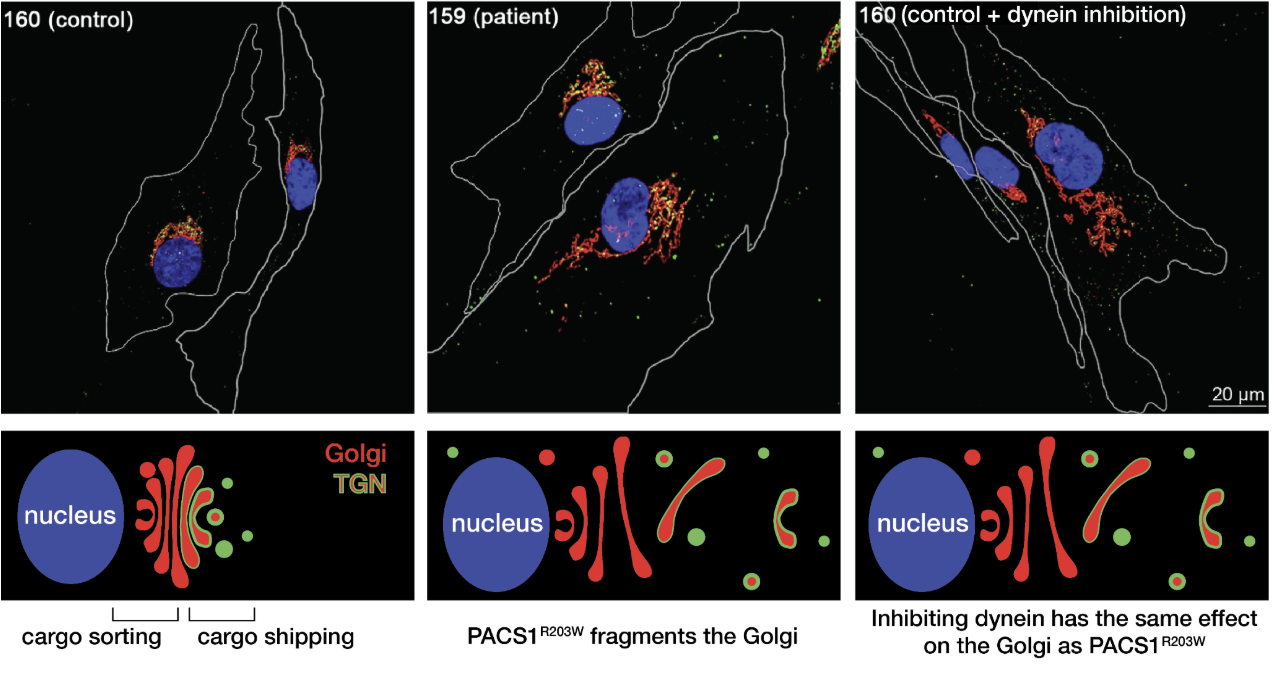
Figure 1d (adapted); Yang et al., 2026
PACS1R203W slows down dynein, and is counteracted by other dynein regulators
By now, the scientists had figured out that PACS1 interfered with dynein’s ability to move, and that this interference broke up the Golgi. In their earlier co-immunoprecipitation “fishing” experiment, they had pulled out more than just the dynein motor; they also saw that PACS1 interacted with a cargo adaptor protein called BICD2 that helps dynein recognize and grab onto its correct cargo.
To figure out how PACS1 affects dynein’s ability to grab and carry cargo via BICD2, the scientists used a tool to artificially stick an easy-to-see cargo onto BICD2. Now, if dynein hitched on to BICD2, they could watch this cargo through a microscope to see how far and fast dynein moved in the presence of PACS1 or PACS1R203W. They showed that dynein moved cargo less quickly and less often when PACS1R203W was present compared to PACS1.
In science, to show as convincingly as possible that you’ve really identified the correct cellular pathway involved in a disease you care about, you can do something called a “rescue” experiment. In a rescue experiment, you try to cancel out the effect a mutation has on a pathway by turning another part of that pathway up or down. Since PACS1R203W makes dynein work worse, in order to show that dynein was absolutely the reason for the Golgi fragmentation they saw, these scientists used a dynein regulator called Lis1. They showed that increasing Lis1 in patient PACS1R203W cells made dynein move more like the way that it did in non-patient cells. Restoring the way dynein moved also restored the appearance of the Golgi to how it looks in non-patient cells.
From all their experiments together, the scientists concluded that PACS1R203W makes dynein a less efficient motor. They showed that PACS1R203W interferes with the adaptor BICD2 that should help dynein keep the Golgi organized, and that PACS1 patient cells have disperse Golgi. Last, they confirmed their pathway by canceling out the effects of PACS1R203W using another dynein regulator, Lis1.
Conclusions and perspectives
Interestingly, the effects of PACS1R203W on the Golgi that were seen in this study seemed to differ depending on which stage of growth the cells were at. Additionally, in a previous research project done by these scientists, they showed that PACS1 also affects the microtubules that dynein walks on; however, another group doing similar research did not detect effects that PACS1R203W had on either the Golgi or the microtubules.
Most excitingly of all, the first PACS1 patient was successfully treated a few months before this research was published, and the experiments in this paper might give a better idea of how that treatment worked inside the patient’s cells. Recall that PACS1R203W causes a “gain of function,” and all the effects of the mutation that we see in cells are caused by mutant PACS1 being overactive and binding to dynein too strongly. If PACS1R203W is being too active, reducing the amount of protein should bring the PACS1 activity level closer to what it is in non-patient cells. To accomplish this, a technology called AntiSense Oligonucleotides (ASOs) was used.
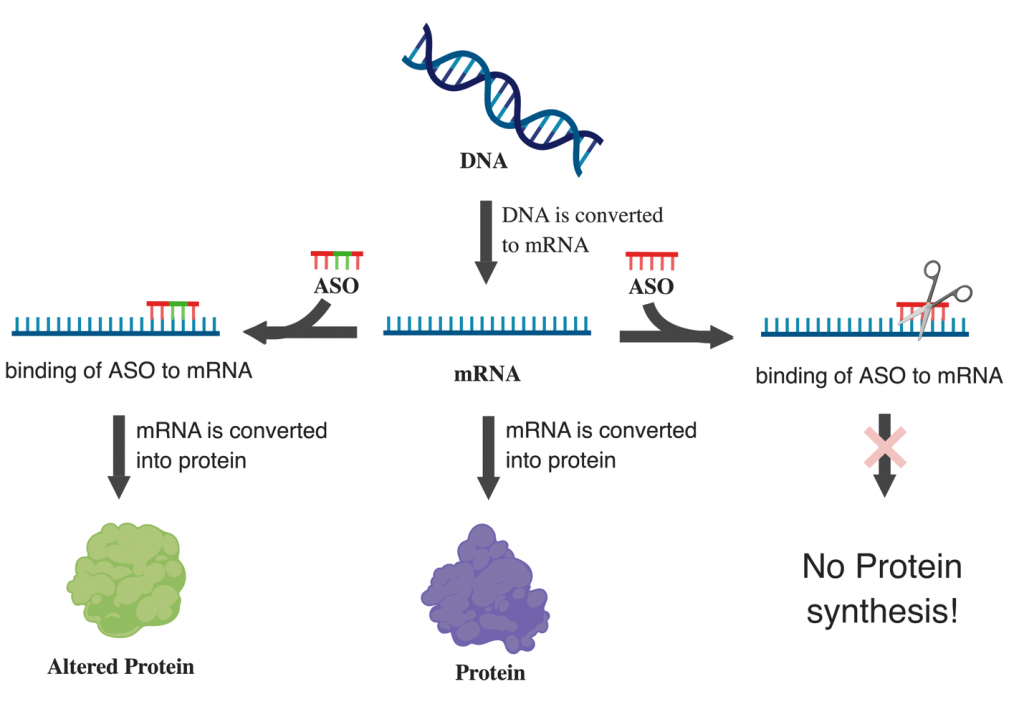
How ASOs work in the human body. Image by Larissa Nitschke, Created with BioRender. Shared by National Ataxia Foundation.
Briefly, ASOs work by interrupting the transmission of information between the gene (encoded by DNA) that contains the instructions for making a protein, and the machinery that build proteins. That machinery relies on a message, encoded by a special type of RNA called mRNA. This mRNA is a copy of the protein-making instructions in DNA that is transported out of the nucleus to where the protein-making machinery is. ASOs stick to the mRNA and cause some of it to be destroyed, resulting in less production of the protein (in this case, less PACS1R203W).
ASOs are considered to be safer than directly editing a person’s genome because they do not have a permanent effect on the genetic code, only on the way this code is interpreted. However, they usually require multiple doses, and work best for gain-of-function mutations (although interesting research is underway to build ASOs that can also counteract loss-of-function mutations). For the PACS1 patient who was treated, lowering the amount of hyperactive PACS1R203W in their cells likely meant dynein was less inhibited and could be as effective a motor as it is in non-patient cells. Studies like this one are important for knowing how treatments work so they can be made stronger, safer, and more individualized.
Citation: Yang, Y., Thomas, L., Chen, K. et al. PACS1 syndrome mutation disrupts dynein-mediated cargo transport via HDAC6 and BICD2. Commun Biol 9, 450 (2026). https://doi.org/10.1038/s42003-026-09924-0