

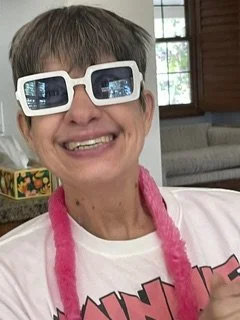
Nicole is a 52 year old woman living with DYNC1H1-Related Disorder.
John, father to Nicole, shared about their experiences.
Can you describe Nicole and some of her favorite things?
“Nicole is really outgoing, she loves people. She loves to show you her socks and her shirt, or high fiving people. She loves to dress up and wear clothes with her favorite characters like Snoopy and Mickey Mouse. Some of her favorite places to eat are Wendy’s McDonald’s. and Burger King. She is amazing at puzzles; she will pick up a piece and know right where it goes. She’s also very good at sorting and matching, for example she has a sock drawer that is all mixed up, and she will sit there and find the matching sock to the one she chose for the day.”
Can you tell me some background about Nicole’s journey and how she was first diagnosed?
“When she was born, we didn’t notice a disability until about three months. At that point, she wasn’t meeting milestones, like holding her head up or rolling over. The doctors were trying to figure out what was going on with Nicole and could not find any answers.
Nicole had scoliosis when she was an infant and she had surgery to get her spine straightened when she was about 10 years old. Up until the age of 14 she could walk in an unusual way and kind of throw her hips forward. She had braces for her feet because they were deformed and could not provide the typical support.
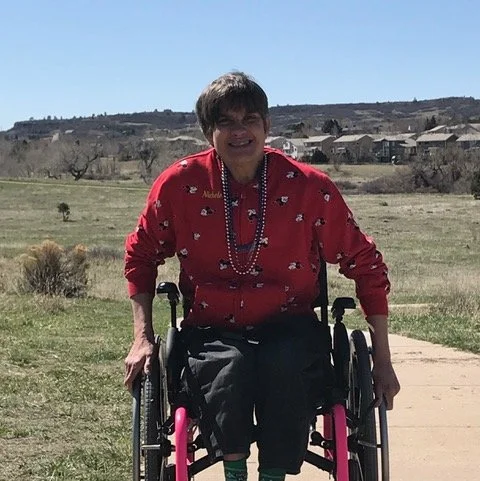
Nicole has also had seizures since probably age two or three. She has serious behaviors, but these have become less frequent and violent as she’s gotten older. She has slow gut motility, which means her gut muscles aren’t particularly active. She has very little muscle development below the waist. She’s in a wheelchair most of the time but uses a walker in the house. About two years ago we got genetic testing done, found the DYNC1H1 variant, and were about to get more clarity.
I have pretty much had sole responsibility for Nicole, who has lived with me. Growing up she went to a special education school, and she now goes to a day program. She has been going there for the past 20 plus years and loves to spend time with the staff there. She is currently living in a host home.”
What prompted you to get genetic testing and what was your experience like receiving that diagnosis after so many years?
“During the first 50 years, none of Nicole’s doctors suggested genetic testing. We were then referred to a doctor who had expertise in people with developmental disabilities who suggested it.
I think that a lot of people would say, that this doesn’t change who Nicole is and move on I think that for me, it was really helpful. I have been fascinated by the scientific information. I watched a video on the DYNC1H1 website, explaining how variants in the gene can impact the movement of the dynein protein and how this can affect the brain and development, and found this to be very interesting. I also found it helpful to share this information with Nicole’s team and different people in our lives. Overall, I think it gave people more actionable information.
Since receiving the diagnosis, we were surprised that people with the same mutation could have such different experiences. The nice thing is we now have things like Simons Searchlight where we can build a database of shareable information for healthcare providers and parents.”
How has Nicole’s symptoms changed overtime? Which of her symptoms have been most difficult to manage?
“Nicole’s symptoms have changed as she’s aged. More specifically, for hormonal changes and menopause it was a noticeable change. Her overall physical abilities maintained well. What I’m trying to do with her team now, is to make sure that we are all understanding that aging is going to have some physical effect and we need to be aware of keeping her mobility. I would say that Nicole’s behaviors got worse as she went through her puberty years and as a young adult. Since menopause, I think her behaviors have decreased in severity and frequency. Her seizures have been pretty much the same for the last 30 years. She’s on the same medication that she’s been on for probably 20 years. It can also be challenging to manage because when she experiences stress she may have seizures.”
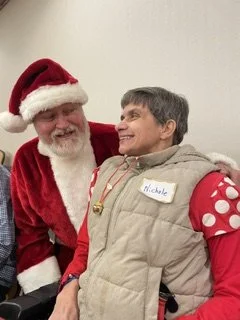
We thank Caroline for conducting the interview, as well as Nicole and her father, John, for sharing their experiences. If you are a family interested in sharing your story, we’d love to hear from you! Email us at contact@dync1h1.org.
Want to support finding cures for people like Nicole? Donate to the DYNC1H1 Association, the only 501c3 Nonprofit dedicated to accelerating research for treatments in DYNC1H1-related Disorders.